The Brake Rotor Replacement Upsell Is One of the Oldest Tricks in the Shop — Here's How to See Through It
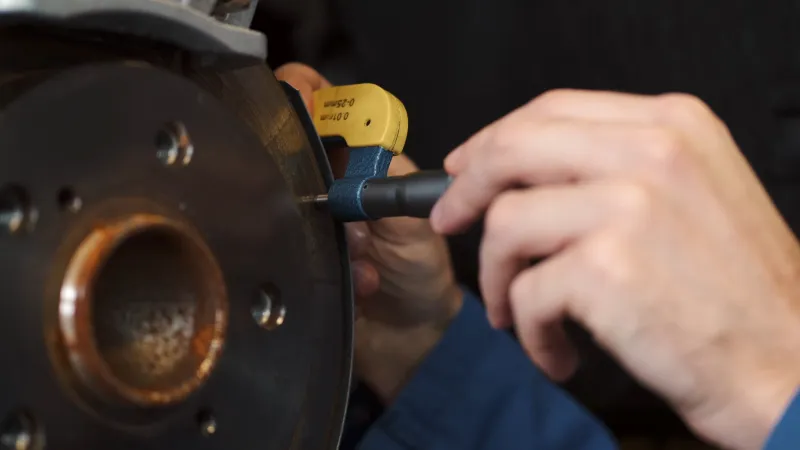
Photo: mechanic measuring brake rotor with micrometer in auto repair shop, via images.pexels.com
The Brake Rotor Replacement Upsell Is One of the Oldest Tricks in the Shop — Here's How to See Through It
Brake jobs have a reputation for being honest, necessary work. Unlike some automotive services where the line between maintenance and upselling gets blurry, brakes feel different — safety is on the line, and most people don't push back when a mechanic says something needs replacing.
That's exactly why the rotor replacement upsell has been so effective for so long.
The pitch usually goes like this: you come in for new brake pads, the tech pulls the wheels, and the service advisor comes back with the news that your rotors are "worn" or "warped" and need to be replaced along with the pads. The total climbs from $150 to $400 or more, and most people say yes because what are you going to do — argue about your brakes?
Here's what the industry doesn't advertise: a large percentage of those rotors could have been resurfaced instead of replaced, at a fraction of the cost. The reason resurfacing has nearly vanished from most shops has nothing to do with safety and almost everything to do with margins.
What Resurfacing Actually Is
Brake rotors — the metal discs that your brake pads clamp against to slow the car — wear down over time. The friction surface develops grooves, minor scoring, and microscopic variations in thickness that can cause vibration, pulsing in the pedal, and reduced stopping efficiency. None of this means the rotor is done.
Resurfacing, also called "turning" a rotor, involves mounting it on a brake lathe — a machine that spins the rotor and shaves a thin, uniform layer from both friction surfaces. The result is a flat, smooth surface that performs like new. The process takes roughly fifteen to twenty minutes per rotor and has been standard brake shop practice since the 1950s.
For decades, resurfacing was the default. Replacement was reserved for rotors that were cracked, deeply grooved beyond what the lathe could fix, or worn below a specific minimum thickness threshold. That threshold matters — and we'll get to it.
When Replacement Quietly Became the Default
The shift started becoming noticeable in the late 1990s and accelerated through the 2000s. A few things converged to make it happen.
First, cheap imported rotors flooded the aftermarket. The price gap between a new budget rotor and the labor cost of resurfacing an old one narrowed considerably. For a shop, selling a new part at markup is more profitable than selling a service that consumes a technician's time and equipment wear.
Second, brake lathes require maintenance, calibration, and occasional tooling replacement. Some shops quietly let their lathes fall into disrepair or sold them off entirely, which conveniently eliminated resurfacing as an option they'd have to offer.
Third — and this is the part nobody talks about openly — warranty claims on resurfaced rotors are messier than on new parts. If a customer comes back with brake pulsation after a resurface, the shop has to eat that. A new part comes with a manufacturer warranty the shop can point to.
The result is that "replace the rotors" became the path of least resistance in most shops, regardless of whether it was actually necessary.
The Number That Changes Everything
Every brake rotor manufactured for sale in the United States has two measurements stamped or cast into it. One is the nominal thickness — what the rotor measures when new. The other is the minimum thickness, sometimes labeled "MIN TH" or "DISCARD" on the rotor's hat or edge.
That minimum thickness number is the only measurement that actually determines whether a rotor needs replacing. If the rotor is still above that number — and has enough material remaining to be safely resurfaced — it can be turned. Period. That's not a matter of opinion; it's an engineering specification set by the manufacturer.
Measuring a rotor requires a tool called a micrometer (sometimes called a brake micrometer or disc brake caliper). You can buy one at AutoZone, O'Reilly, or Advance Auto Parts for somewhere between $10 and $20. The measurement takes about thirty seconds once you know where to check — and the correct locations are: near the outer edge, near the inner edge, and in the middle of the friction surface, at multiple points around the circumference to check for uneven wear.
If your measurements come in above the discard spec, your rotors have life left. A shop offering only replacement at that point is not giving you a complete picture.
When Replacement Really Is the Right Call
None of this means replacement is always wrong. There are genuine situations where new rotors make more sense.
If the rotor is at or below minimum thickness, resurfacing removes material you can't spare — that's a safety issue, full stop. If the rotor has deep radial grooves that exceed roughly 1.5mm in depth, a lathe may not be able to fully clean it up before hitting minimum spec. Cracks of any kind — even hairline — mean replacement, no argument.
Modern rotors, especially on smaller economy cars, are also manufactured thinner than older designs to save weight. Some of them arrive from the factory with barely enough material to survive one brake pad change before hitting discard spec. On those vehicles, resurfacing may genuinely not be viable. Your micrometer will tell you.
And if you're putting high-performance pads on a track-day car or upgrading to slotted or drilled rotors, you're replacing them anyway. This conversation is for the vast majority of daily drivers getting standard brake service.
How to Walk Into the Shop With the Upper Hand
Before any brake service, grab a micrometer and measure your rotors. Write the numbers down. Find your vehicle's discard spec — it's stamped on the rotor itself, or in any factory service manual, or on sites like AllData DIY. Walk in knowing whether your rotors are above or below spec.
 Photo: AllData DIY, via thecompleteportal.com
If they're above spec and a shop tells you they need replacing, ask specifically why. "They're worn" isn't an answer. Ask for the measured thickness and compare it to the discard spec. If they can't produce that number, that tells you something.
This isn't about being adversarial with your mechanic. Most technicians are honest people working within a system that pushes toward replacement. But an informed customer asking the right question changes that dynamic immediately.
Twelve dollars and five minutes of measuring could save you a couple hundred bucks on your next brake job. That's not a bad return on curiosity.