Your Car Is Trying to Tell You Something — And Most Drivers Have No Idea What It's Saying
Your Car Is Trying to Tell You Something — And Most Drivers Have No Idea What It's Saying
There's a moment almost every driver knows. A little amber or red glyph flickers to life somewhere on the dashboard, and instead of pulling over, the internal negotiation begins. Is it serious? It's probably nothing. I'll Google it later. Later never comes, and the light either disappears on its own or the car does something expensive and dramatic.
The check engine light gets all the attention — it's practically a cultural punchline at this point. But your dashboard is running a whole conversation that most drivers are completely tuned out of. Dozens of symbols, each with a specific meaning, sit dormant until something goes wrong. And when they light up, most people have no idea what they're actually being told.
Here's the part of your owner's manual nobody actually reads — translated into plain English.
The Brake Light That Isn't Just About Your Parking Brake
The red exclamation point inside a circle — sometimes flanked by parentheses — is one of the most misread symbols on any dashboard. Most drivers assume it means the parking brake is engaged. And sometimes, that's exactly right. But if that light stays on after you've released the parking brake? That's your car telling you the brake fluid is critically low.
Low brake fluid isn't a "top it off and move on" situation. It usually means one of two things: there's a leak somewhere in the brake system, or your brake pads are worn so far down that the caliper pistons have extended to compensate, dropping the fluid level in the reservoir. Either way, continuing to drive is genuinely dangerous. This is one of the few dashboard lights where "I'll deal with it this weekend" is the wrong answer.
The Tire Shape That Points to a Specific Wheel
Most people know what the tire pressure monitoring system (TPMS) light looks like — that flat tire cross-section with an exclamation mark. What most people don't realize is that many modern vehicles don't just flag low pressure generically. They pinpoint which tire is losing air.
On cars with individual sensor readouts (usually visible through the infotainment screen or instrument cluster sub-menu), each wheel has its own pressure reading. That means if your front passenger tire is at 24 PSI while everything else sits at 35, the car already knows. You don't have to walk around with a gauge guessing. Check the detailed readout before you assume it's a universal pressure drop from cold weather — which, by the way, is a real phenomenon. Tire pressure drops roughly one PSI for every 10-degree Fahrenheit drop in temperature.
The Symbol That Looks Like a Thermometer Drowning
A thermometer submerged in wavy lines — usually glowing blue — is your engine coolant temperature warning. Blue means the engine is still cold, which is normal at startup. But if that symbol turns red, or if you see a red thermometer without waves, your engine is overheating.
An overheating engine is not a "limp to the next exit" situation. It's a pull over right now and shut the car off situation. Running an engine past its thermal limits for even a few minutes can warp cylinder heads, destroy head gaskets, and turn a $200 coolant repair into a $3,000 engine rebuild. The light exists specifically to give you a window of time to act. Use it.
The Battery Icon That Has Nothing to Do With Your Battery
Here's one that tricks even experienced drivers. When the battery-shaped warning light comes on while you're driving — not at startup — it almost never means your battery is dead or dying. What it actually signals is that your alternator has stopped charging the battery properly.
The alternator is what keeps your battery topped off while the engine runs. If it fails, your car is essentially running on a finite reserve of stored electricity. Depending on your battery's charge level, you might have 30 minutes of driving left. You might have five. The smart move is to turn off every non-essential electrical load — air conditioning, heated seats, stereo — and head straight to a shop or safe stopping point. Don't assume you can make it home from across town. Sometimes you can't.
The Wrench, the Gear, and the Slippery Car
A few others worth knowing:
-
The wrench icon (or sometimes a wrench inside an engine outline) typically means a scheduled service is due — oil change, transmission service, or manufacturer-specific maintenance interval. It's not an emergency, but it's not decorative either.
-
An exclamation point inside a gear usually signals a transmission temperature warning or a fault in the automatic transmission system. If this appears, gentle driving and an immediate shop visit are the right moves.
-
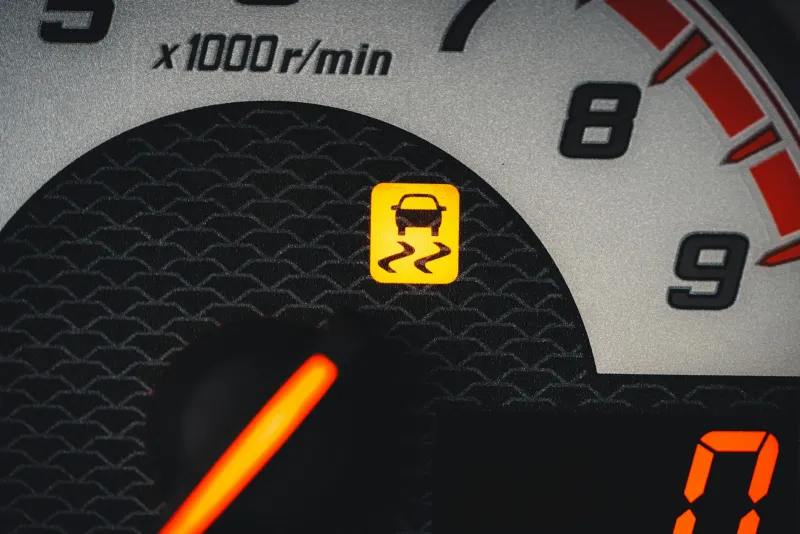
A car with squiggly lines underneath it is your traction control or stability control system kicking in — or being disabled. If it's flashing while you drive, the system is actively working to keep you from sliding. If it's solid, someone (maybe you, maybe a previous owner) turned the system off manually.
Why Nobody Taught You This
It's a little strange when you think about it. Cars come with owner's manuals that explain every single one of these symbols in the appendix. But nobody reads them, dealerships don't walk new buyers through them, and driver's education courses barely scratch the surface. The result is that millions of people are driving around in vehicles that are actively communicating a problem — and getting nothing but a shrug in return.
The fix is genuinely simple. Spend twenty minutes with your car's owner's manual — or pull up a digital version for your specific make and model — and just read the warning light section. It's not thrilling reading. But the next time something lights up on your dash, you'll know exactly what your car is trying to say. And you might save yourself a very expensive lesson in the process.