The Road Surface That Recycles Millions of Tires, Drives Like a Dream, and Still Lost
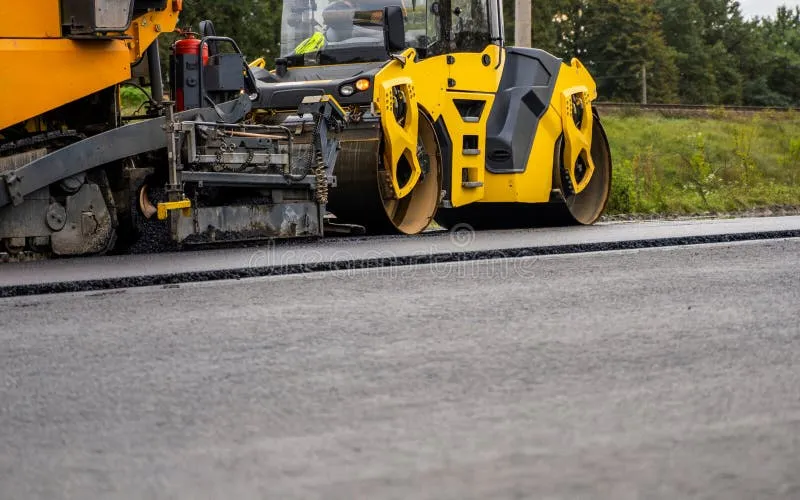
Photo: rubberized asphalt road paving machine fresh asphalt highway surface, via thumbs.dreamstime.com
Drive on a stretch of rubberized asphalt and something feels off — in a good way. The road is quieter. Noticeably quieter, like someone turned down the ambient hum of traffic by a few notches. The surface grips a little better in the rain. And over the years, it just doesn't crack the way ordinary asphalt does.
The kicker? Each lane-mile of the stuff buries roughly 2,000 scrap tires that would otherwise be sitting in a landfill — or worse, burning in the massive tire fires that have plagued the country for a century.
So why isn't every road in America paved with it? The answer is a genuinely strange story of desert experimentation, screaming tire piles, and cost accounting that can't hear the difference.
Born in the Land of Endless Highway
The technology traces back to the 1960s, when asphalt engineers started experimenting with crumb rubber — ground-up scrap tire material — blended into hot asphalt binder. The idea made intuitive sense. Tires are engineered to flex, absorb impact, and resist wear. Why not build those properties into the road itself?
Arizona became the proving ground. The state had two abundant resources: brutal sun that destroys conventional pavement, and a growing scrap tire problem. Phoenix's famous 'rubberized asphalt' program, run through the Maricopa County region and refined by state and university researchers, showed that rubber-modified overlays could dramatically reduce reflective cracking — the fractures that march up from an old road surface into a fresh layer of asphalt.
California followed with its own large-scale trials, particularly on highways and city streets where noise was the complaint. Caltrans studies and independent acoustic measurements found that rubberized asphalt could cut tire-road noise by 50% or more compared to conventional surfaces — the equivalent of halving traffic volume, acoustically speaking. Residents along resurfaced corridors reported the change immediately. Some described it as the road 'going soft' under the tires.
The Physics of a Quieter, Tougher Road
The magic is in what the rubber does to the binder. Conventional asphalt gets brittle in cold weather and soft in extreme heat, which is why it cracks and ruts. Crumb rubber keeps the binder flexible across a much wider temperature range. The pavement essentially stretches instead of snapping, which is why rubberized overlays routinely last longer between repairs.
The noise reduction comes from the surface texture. Rubberized pavement can be laid with a finer, more uniform surface that dampens the tiny air-pump vibrations between tire and road — the main source of highway hiss. It's the same reason your car sounds different on concrete versus fresh asphalt, amplified into something you can measure from a block away.
There's even a safety dividend: the rubber content improves skid resistance, and the material's flexibility helps it shed water effectively.
So Why Didn't It Take Over?
Here's where the story turns frustrating. Rubberized asphalt costs more up front — historically 30% to 100% more per ton than conventional asphalt, depending on oil prices and rubber supply. On a spreadsheet, in the year it's laid, that looks like a loss.
But the longer math tells a different story. Fewer cracks mean fewer overlay cycles. Longer pavement life means deferred reconstruction. Reduced noise means highway agencies can sometimes skip expensive noise walls or sound insulation programs for nearby homes. Several analyses over the years concluded that rubberized asphalt is at or near cost parity over its lifespan — and that's before counting the landfill diversion.
The problem is that no single agency owns all those savings. The paving budget is separate from the maintenance budget, which is separate from the noise-mitigation budget. A public works director evaluated on this year's paving contract has little incentive to pay a premium for benefits that show up on someone else's ledger in year twelve.
Add in genuine technical skepticism — early mixes in colder climates had performance problems, and some contractors found the material finicky to work with — plus an asphalt industry with entrenched supply chains, and you get the outcome we have: a proven, better road surface that covers a fraction of American miles.
A Second Act Sitting in Plain Sight
The scrap tire problem never went away. Americans generate close to 300 million scrap tires a year, and while recycling rates have improved, tire-derived material still needs markets. Rubberized asphalt is arguably the highest-value use available: it's a premium pavement additive made from a waste stream.
Some states have quietly kept the faith. Texas, Arizona, and California continue regular use. Others have revisited the technology as noise complaints and sustainability mandates grow. And as climate extremes punish conventional pavement harder — longer heat waves, deeper freeze-thaw cycles — the flexible-road argument gets stronger every year.
The lesson here isn't really about asphalt. It's about how good ideas die in the gap between 'cheaper this year' and 'better for twenty.' America already invented the road that's quieter, lasts longer, and eats garbage tires for breakfast. It's just been waiting, mostly in the Southwest, for the accounting to catch up with the engineering.